
Practical ways AI tools help adult learners bridge cultural, administrative, and professional gaps.
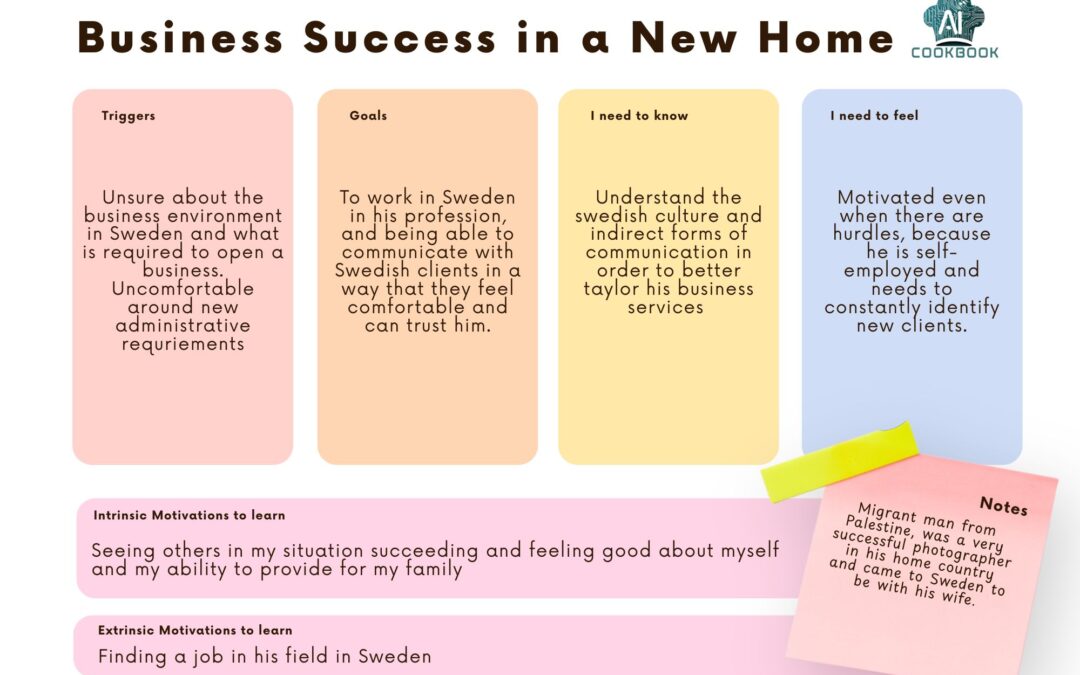
As educators working with migrant and displaced professionals, we often meet people like the persona in our recent case file, let's call him Mahmoud. A successful photographer from Palestine, he came to Sweden to be with his wife. Now he faces three overlapping challenges:
- Uncertainty about Swedish business and administrative systems.
- A need to communicate with Swedish clients.
- The daily pressure to provide for his family while managing self-employment hurdles.
His motivations are both intrinsic (seeing others like him succeed, feeling capable) and extrinsic (finding a job in his field). As education professionals, we cannot redesign Sweden's bureaucracy overnight. But we can equip learners with tools.
Here are four ways AI can support Mahmoud's learning journey and yours as an educator.
1. Decision Trees and Rule-Based AI for Business Registration
Iberika feels uncomfortable with new administrative requirements. A standard PDF guide overwhelms him. A rule-based AI system (often called an "expert system" or "decision tree") can guide him step by step.
How it works:
The system asks simple yes/no or multiple-choice questions, and each answer leads to the next relevant question. No language generation occurs—only pre-written rules.
Example interaction:
System: "Will you work alone or hire employees?"
Mahmoud: "Alone."
System: "Then you need an F-skatt. Do you already have a Swedish personal identity number?"
Mahmoud: "Yes."
System: "Your next step is to visit Verksamt.se and click 'Register sole proprietorship.' Here is a PDF with only the 3 pages relevant to you."
Where to find this:
- Many Swedish municipality websites already use rule-based AI in their "business startup wizards."
- You can build simple versions using Google Forms with conditional logic or software like Typeform, Lucidchart, or even Excel with nested IF statements.
Educator tip:
Help Iberika bookmark the official Verksamt.se wizard. Then have him write down the sequence of answers he gave, so he can repeat the process independently next time.. Practicing Indirect Swedish Communication Through Real-Time Translation
Mahmoud knows that Swedish clients value humble, indirect, and low-key communication. Learning this cultural script takes more than reading a guide.
2. Ask a GPT to act as a politeness checker
AI support:
Use an LLM as a politeness translator. Provide examples of "direct" versus "indirect" phrasing, then ask the AI to rewrite.
Classroom / 1:1 activity example:
Mahmoud writes: "I am the best photographer in town. Hire me."
AI rewrites (Swedish style): "I enjoy working with light and people. Several clients have told me they appreciate my calm approach. If you are looking for natural, unposed photos, I would be happy to share examples."
Educator tip:
Have learners compare AI-generated versions, then role-play with classmates. AI provides a low-stakes rehearsal space for cultural pragmatics - one step before real conversation.
3. Building a "Client Tone Checker" for Emails and Proposals
Mahmoud constantly needs to find new clients. He may lack a Swedish mentor late at night when drafting a proposal.
AI workflow:
- Learner pastes a draft email.
- AI checks for:
- Overly direct phrasing (e.g., "You must pay 50% now" → "A typical practice here is 50% upfront, which I'm happy to explain further")
- The right lagom tone (balanced, calm, professional)
- Language that prioritizes client comfort (e.g., "No stress—we can talk first")
Sample educator prompt to share:
"You are an AI cultural bridge. Rewrite this photographer's email to a Swedish client so it sounds trustworthy, calm, and professional—without being salesy."
Over time, Mahmoud internalises the rhythm. AI acts as a gradual training tool, enabling independence step by step.
4. Boosting Intrinsic Motivation with Personalized Success Narratives
Mahmoud's deepest motivation comes from seeing others like him succeed and knowing he can provide for his family. AI can generate personalised analogies that connect his past wins to a Swedish future.
Try this in class:
Ask Mahmoud to describe one past professional achievement (e.g., "I photographed a large wedding under difficult lighting conditions"). Then prompt the AI:
"Tell that story as if it happened to a photographer in Malmö who now runs a successful business. What did he learn about earning Swedish client trust?"
The AI reframes his own expertise within a Swedish context. For learners without local role models, AI makes an invisible career path feel visible and achievable.
A Note on Educator Judgment
AI works best as scaffolding. Mahmoud still needs:
- A human mentor who can confirm critical administrative steps
- Practice with real Swedish clients in low-stakes settings first
- Your empathy when he feels uncomfortable. His discomfort signals high professional standards adapting to a new culture
Use AI to build confidence and clarity. The goal is for Mahmoud to eventually say, "I know how to sound Swedish on my own."
Final Question for You
Think of one learner in your program who struggles with administrative overwhelm or indirect communication. What one AI-supported task could you co‑design with them this week?
If you try this approach with a learner like Mahmoud, share your results.
You can find more learner and educator personas in our Tools
Soon we will be publishing full 'Recipes' explaining how to use AI to support migrant learners in different contexts.