
Custom Instructions for LLMs to Support Epistemic Awareness
A short instructional activity in which educators and learners configure custom instructions for a Large Language Model in order to develop epistemic awareness, critical reasoning, and responsible AI-supported learning under conditions of uncertainty.
Τομέας(-είς) ικανοτήτων DigCompEdu
Empowering learners, Facilitating learners’ digital competence
Χρόνος
Προετοιμασία: 15 λεπτά ·
Implementation time 30 minutes
Επίπεδο Εξέλιξης Εκπαιδευτικού
Ολοκληρωτής
Ομάδες-στόχοι
Adult education teachers and trainers who use Large Language Models and want to establish a critical and responsible approach to AI use.Adult learners using AI tools for study or support, who need to develop basic AI literacy and an understanding of how AI handles knowledge and uncertainty
Ελάχιστο επίπεδο ψηφιακών δεξιοτήτων των μαθητών
Μεσαίο
Ελάχιστο επίπεδο γλωσσομάθειας του μαθητή
B2
🎓 Μαθησιακοί Στόχοι
Educators and learners will be able to…
- Configure custom instructions that support critical reasoning, transparency, and responsible AI-supported work
- Explain that Large Language Models do not possess knowledge, but generate probabilistic reasoning based on patterns in data
- Reflect on their own responsibility when using AI tools in educational and learning contexts.
Συστατικά
| Είδος / Πόρος | Ποσότητα | Σκοπός |
|---|---|---|
| AI tool (e.g. ChatGPT or other LLM with custom instructions) | 1 per learner | Used to configure a critical interaction mode that supports epistemological awareness and responsible AI use. |
| Custom instruction text (provided) | 1 | Establishes rules for handling uncertainty, credibility, and critical dialogue when interacting with the AI. |
Εξοπλισμός
Internet-connected device + access to an LLM with custom settings
🥣 Προετοιμασία – Πριν από την υλοποίηση
- The teacher learns first and then teaches the learners.
- Before classroom use, the educator inserts the provided custom instructions into the AI tool and independently explores their effect by asking ordinary questions and observing changes in AI behaviour. This exploration phase allows the educator to investigate how the instructions influence responses related to uncertainty, missing information, and critical counterpoints.
- Only after this exploratory phase does the educator introduce the activity to learners.
🔥 Βήματα υλοποίησης
- The educator briefly introduces the key idea from the shared reference text found in References & Resources: that Large Language Models do not “know”, but generate responses based on likelihood, and that AI output must therefore be treated as provisional reasoning rather than authoritative knowledge.
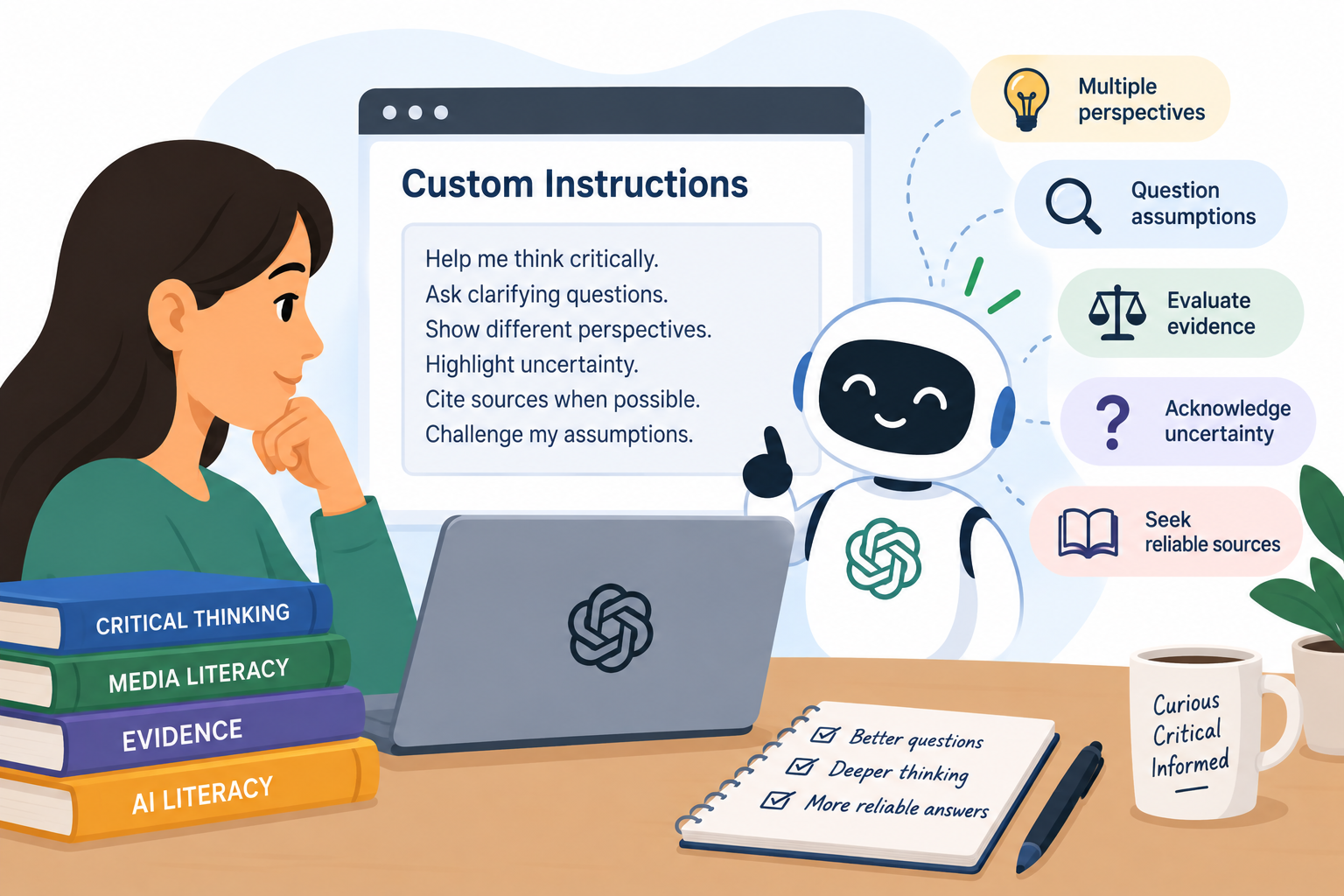
- Students open their AI tool and insert the custom instruction text provided in References & Resources into Custom Instructions / Settings. The text (in image form) presents a structured set of rules for handling uncertainty, credibility, and dialogue.
- Students ask the AI one or two ordinary questions and observe how the responses differ when the custom instructions are active, particularly in situations involving uncertainty or incomplete information.
- The educator facilitates a brief discussion on how the AI’s behaviour changed and how the custom instructions support an epistemological approach to AI use.
🧂 Διαφοροποίηση και Συμπερίληψη
- By working with shared principles for handling uncertainty, credibility, and dialogue, the activity models how inclusive learning design can be achieved through clear structures and reflective use of AI.
🍴 Αξιολόγηση και ανατροφοδότηση
| Κριτήριο | Έξοχα | Καλά | Χρειάζεται δουλειά |
| Epistemic understanding | Clearly distinguishes between knowledge, assumptions, and uncertainty in AI responses. | Recognises uncertainty in AI responses, but distinctions are not always clear. | Treats AI output as mostly authoritative. |
| Use of custom instructions | Clearly explains how the instructions change AI behaviour, with examples. | Notices changes in AI behaviour after applying instructions, but has difficulty explaining the effect of the instructions. | Does not notice the AI’s change in behaviour after applying instructions. |
| Reflective judgement | Critically evaluates AI output and takes clear human responsibility. | Shows some critical reflection, but relies on AI output at times. | Accepts AI output with little or no reflection. |
⚠️ Ηθική, Ιδιωτικότητα & Διασφάλιση Προστασίας
🍱 Επεκτάσεις / Συνέχειες
- Reuse the custom instructions in other AI tools.
- Compare AI responses with and without the instructions applied.
- Reflect on how the instructions affect credibility and uncertainty.