
Course in Universal Design for Learning (UDL)
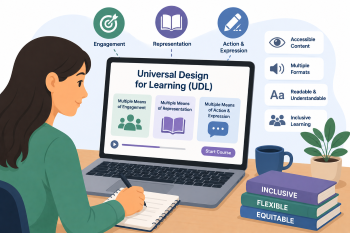
A 45-minute workshop in which language school teachers are introduced to Universal Design for Learning (UDL) while simultaneously learning to use Google LM’s Notebook and Study features (e.g. podcast and quiz) as tools for ethical, inclusive learning design and professional development.
Τομέας(-είς) ικανοτήτων DigCompEdu
Professional engagement, Digital resources, Teaching & learning, Assessment, Empowering learners, Facilitating learners’ digital competence
Χρόνος
Preparation time 60 minutes
Implementation time 45 minutes
Επίπεδο Εξέλιξης Εκπαιδευτικού
Νεοφερμένος
Ομάδες-στόχοι
Students’ Digital Skill Level None Basic Intermediate Advanced
Ελάχιστο επίπεδο ψηφιακών δεξιοτήτων των μαθητών
Βασικό
Ελάχιστο επίπεδο γλωσσομάθειας του μαθητή
A1
🎓 Μαθησιακοί Στόχοι
Educators will be able to…
- Explain the core principles of Universal Design for Learning (UDL).
- Recognize how different study formats (text, audio, quiz) support different UDL dimensions.
- Use Google LM’s Notebook and Study features to explore and learn new pedagogical content.
- Reflect on how AI-supported study tools can support inclusive didactic planning in adult language education
Συστατικά
| Είδος / Πόρος | Ποσότητα | Σκοπός |
|---|---|---|
| AI tool(s): Google LM (Notebook & Study features) | 1 per learner | Used as the primary learning environment. |
| AI-generated and trainer-curated UDL learning materials (PDF) | 1 set | Uploaded to Google LM Notebook to model how theoretical content can be studied through multiple formats. |
| Content materials (UDL framework excerpts, examples) | Selected | Provide a shared theoretical reference point for all learners and support structured discussion and reflection. |
Εξοπλισμός
Internet-connected device (laptop or tablet) + access to Google LM
🥣 Προετοιμασία – Πριν από την υλοποίηση
The revised research-based content is exported as PDF-files and uploaded to Google LM Notebook, where it functions as the central study material for the workshop.
🔥 Βήματα υλοποίησης
- The trainer introduces the core principles of Universal Design for Learning (UDL) and explains how Google LM will be used as a study environment rather than a content production tool.
- Learners access the uploaded UDL research PDFs in Google LM Notebook and explore the content using selected Study features, including:
- AI-generated summaries
- Quiz-based knowledge checks
- Podcast-style audio explanations
- Key-point extraction
🧂 Διαφοροποίηση και Συμπερίληψη
By experiencing multiple study formats when engaging with the same theoretical content, educators explore how differentiation can be embedded in learning design rather than implemented as individual adaptations.
🍴 Αξιολόγηση και ανατροφοδότηση
| Κριτήριο | Έξοχα | Καλά | Χρειάζεται δουλειά |
| Understanding of UDL principles | Demonstrates a clear and accurate understanding of the core UDL principles and their purpose. | Shows a basic understanding of UDL principles with minor inaccuracies. | Limited or unclear understanding of UDL principles. |
| Use of Google LM Study features | Actively explores multiple Study features and reflects on their didactic potential. | Uses selected Study features with limited reflection. | Minimal engagement with Study features. |
⚠️ Ηθική, Ιδιωτικότητα & Διασφάλιση Προστασίας
- Educators are informed not to upload personal data, sensitive information, or identifiable learner data when using Google LM. All materials used in the workshop should be generic and research based.
- Be aware that AI-generated outputs are merely supporting tools, not authoritative sources.
🍱 Επεκτάσεις / Συνέχειες
Educators are encouraged to further explore Google LM’s Study features using their own professional reading or research texts.
🔗 Σύνδεση μεταξύ γνωστικών αντικειμένων
Αναφορές και Πηγές
CAST – Universal Design for Learning (UDL) Framework:
Center for Applied Special Technology (CAST), the U.S.-based research organization that developed the UDL framework. CAST was founded by researchers affiliated with Harvard Graduate School of Education and is the primary authoritative source on UDL theory and guidelines. https://udlguidelines.cast.org
Universal Design for Learning: Theory and Practice
Meyer, A., Rose, D. H., & Gordon, D. (2014). Universal Design for Learning: Theory and Practice. CAST Professional Publishing. https://udltheorypractice.cast.org
Google LM Notebook: Google’s AI-supported study and knowledge environment used in the workshop to explore research texts through multiple study formats (e.g. summaries, quizzes, audio). https://notebooklm.google.com