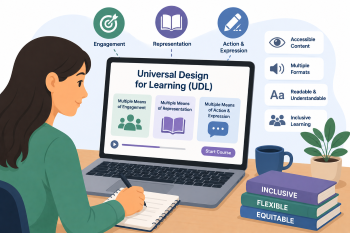
Kurs in Universal Design for Learning (UDL)
Ein 45-minütiger Workshop, in dem Lehrkräfte von Sprachschulen in das „Universal Design for Learning“ (UDL) eingeführt werden und gleichzeitig lernen, die Notebook- und Study-Funktionen von Google LM (z. B. Podcasts und Quizze) als Werkzeuge für eine ethische, inklusive Lerngestaltung und die berufliche Weiterentwicklung zu nutzen.
DigCompEdu-Kompetenzbereich(e)
Berufliches Engagement, Digitale Ressourcen, Lehren & Lernen, Evaluation, Lernerorientierung, Förderung der digitalen Kompetenz der Lernenden
Zeit
Vorbereitung: 60 Min.
Umsetzung: 45 Min.
Progressionsniveau der Lehrkräfte
Einsteiger - Vorreiter
Zielgruppe
Digitales Kompetenzniveau der Lernenden: Anfänger - Fortgeschritten
Niveau der digitalen Kompetenzen
Grundstufe
Sprachniveau der Lernenden
A1
🎓 Lernziele
Nach Abschluss der Unterrichtseinheit können Lehrkräfte:
- die Grundprinzipien des Universal Design for Learning (UDL) erläutern
- erkennen, wie verschiedene Lernformate (Text, Audio, Quiz) unterschiedliche UDL-Dimensionen unterstützen
- die Notebook- und Lernfunktionen von Google LM nutzen, um neue pädagogische Inhalte zu erschließen und zu erlernen
- darüber reflektieren, wie KI-gestützte Lerntools eine inklusive didaktische Planung in der sprachlichen Erwachsenenbildung unterstützen können
Zutaten
| Ressource | Anzahl | Zweck |
|---|---|---|
| KI-Tool(s): Google LM (Notebook- & Study-Funktionen) | 1 pro Person | primäre Lernumgebung |
| KI-generierte und von der Lehrkraft kuratierte UDL-Lernmaterialien (PDF) | 1 Set | in Google LM Notebook hochgeladen, um zu veranschaulichen, wie theoretische Inhalte anhand verschiedener Formate erarbeitet werden können |
| inhaltliche Materialien (Auszüge aus dem UDL-Rahmenkonzept, Beispiele) | ausgewählte Materialien | gemeinsamer theoretischer Bezugspunkt für alle Lernenden und unterstützt strukturierte Diskussionen sowie Reflexionsprozesse |
Zubehör
mit dem Internet verbundenes Gerät (Laptop oder Tablet) + Zugriff auf Google LM
🥣 Vorbereitung – Vor dem Einsatz im Unterricht
Die überarbeiteten, auf Forschung basierenden Inhalte werden als PDF-Dateien exportiert und in Google LM Notebook hochgeladen, wo sie als zentrales Lernmaterial für den Workshop dienen.
🔥 Umsetzung (Im Unterricht / Synchron )
- Der Trainer stellt die Grundprinzipien des Universal Design for Learning (UDL) vor und erklärt, wie Google LM als Lernumgebung und nicht als Tool zur Inhaltserstellung verwendet wird.
- Lernende greifen auf die hochgeladenen UDL-Forschungs-PDFs in Google LM Notebook zu und erkunden den Inhalt mithilfe ausgewählter Lernfunktionen, darunter:
- KI-generierte Zusammenfassungen
- Quizbasierter Wissenscheck
- Audio-Erklärungen im Podcast-Stil
- Schlüsselpunktextraktion
🧂 Differenzierung & Inklusion
Indem sie sich mit denselben theoretischen Inhalten in unterschiedlichen Lernformaten auseinandersetzen, erkunden Lehrkräfte, wie Differenzierung in die Lernkonzeption integriert werden kann, anstatt sie lediglich als punktuelle Anpassungen umzusetzen.
🥄 Evaluation & Feedback
| Instrument/Kriterium | Ausgezeichnet | Gut | Verbesserungswürdig |
| Verständnis der UDL-Prinzipien | zeigt ein klares und präzises Verständnis der zentralen UDL-Prinzipien und deren Zweck | zeigt ein grundlegendes Verständnis der UDL-Prinzipien mit geringfügigen Ungenauigkeiten | begrenztes oder unklares Verständnis der UDL-Prinzipien |
| Nutzung der Google LM-Study-Funktionen | setzt sich aktiv mit verschiedenen Study-Funktionen auseinander und reflektiert deren didaktisches Potenzial | nutzt ausgewählte Study-Funktionen mit eingeschränkter Reflexion | zeigt nur minimale Auseinandersetzung mit den Study-Funktionen |
⚠️ Ethik, Datenschutz & Schutzmaßnahmen
- Lehrkräfte werden darauf hingewiesen, bei der Nutzung von Google LM keine personenbezogenen Daten, sensiblen Informationen oder identifizierbare Daten von Lernenden hochzuladen. Alle im Workshop verwendeten Materialien sollten allgemeiner Natur und wissenschaftlich fundiert sein.
- Bitte beachten Sie, dass KI-generierte Ergebnisse lediglich Hilfsmittel und keine maßgeblichen Quellen sind.
🍱 Erweiterungen / Weiterverfolgung
Lehrkräfte werden dazu ermutigt, die Lernfunktionen von Google LM anhand eigener fachlicher Lektüre- oder Forschungstexte weiter zu erkunden.
🔗 Fächerübergreifender Bezug
📚 Weiterführende Literatur & Ressourcen
CAST – Universal Design for Learning (UDL)-Rahmenkonzept:
Center for Applied Special Technology (CAST) ist die in den USA ansässige Forschungsorganisation, die das UDL-Rahmenkonzept entwickelt hat. CAST wurde von Forschern gegründet, die mit der Harvard Graduate School of Education verbunden waren, und gilt als die maßgebliche Quelle für die Theorie und die Richtlinien von UDL. https://udlguidelines.cast.org
Universal Design for Learning: Theorie und Praxis
Meyer, A., Rose, D. H., & Gordon, D. (2014). Universal Design for Learning: Theory and Practice. CAST Professional Publishing. https://udltheorypractice.cast.org
Googles KI-gestützte Lern- und Wissensumgebung, die im Workshop eingesetzt wurde, um Forschungstexte mithilfe verschiedener Lernformate (z. B. Zusammenfassungen, Quizze, Audio) zu erschließen. Google’s AI-supported study and knowledge environment used in the workshop to explore research texts through multiple study formats (e.g. summaries, quizzes, audio). https://notebooklm.google.com