
Using YouTube Transcripts to Create Real-Life Learning Materials
Use YouTube auto-generated transcripts with ChatGPT to create authentic reading, listening, and vocabulary activities from real-world video content for adult language learners.
DigCompEdu Competence Area(s)
Digital resources, Teaching & learning
Time
Preparation time 20 minutes
Implementation time 45 minutes
Educator Progression Level
Explorer
Target groups
Adult language learners B1 – B2 level
Minimum student digital skill level
Basic
Minimum student language level
B1
🎓 Learning Objectives
Students will be able to:
- Extract and use YouTube transcripts to create authentic language learning materials.
- Develop reading comprehension and vocabulary skills from real-world video content.
- Use AI tools to generate differentiated activities based on authentic texts.
Ingredients
| Item / Resource | Quantity | Purpose |
|---|---|---|
| YouTube video with auto-generated captions | 1 per session | Source of authentic transcript text |
| ChatGPT (free or paid version) | 1 per educator | To create activities from the transcript |
| Device with internet access | 1 per learner | To access YouTube and ChatGPT |
| Word processor or Google Docs | 1 per educator | To format and distribute materials |
Utensils
- Computer or tablet with internet access
- YouTube account (not required for viewing)
- ChatGPT account (free version sufficient)
🥣 Preparation – Before Implementation
- Select a YouTube video relevant to your lesson topic (news, documentary, educational content).
- Check that the video has auto-generated or manual captions available.
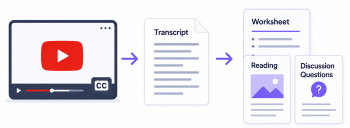
- Open the transcript: click the three dots under the video, select “Open transcript”.
- Copy the transcript text and paste it into ChatGPT for activity generation.
🔥 Implementation Steps
- Show the YouTube video to the class (with or without subtitles depending on level).
- Distribute the transcript or a simplified version as a reading text.
- Use ChatGPT-generated comprehension questions for discussion or written work.
- Assign vocabulary activities based on key terms extracted from the transcript.
- Ask learners to identify key phrases or idioms and discuss their meaning in context.
- Optional: Ask learners to summarise the video in their own words.
🧂 Differentiation & Inclusion
- For lower levels: Provide a pre-simplified version of the transcript with key vocabulary glossed.
- For higher levels: Ask learners to identify persuasive language or rhetorical devices.
- For mixed groups: Assign different comprehension tasks based on proficiency level.
🍴 Assessment & Feedback
| Criterion | Excellent | Good | Needs Work |
| Comprehension accuracy | Answers demonstrate full understanding of the video content | Answers show partial understanding with some gaps | Answers show limited understanding of the content |
| Vocabulary use | Uses key vocabulary from the transcript accurately in context | Uses some vocabulary correctly with minor errors | Vocabulary use is limited or inaccurate |
| Engagement with authentic material | Actively engages with the video and transcript throughout | Engages with most of the material with some prompting | Minimal engagement with the authentic material |
⚠️ Ethics, Privacy & Safeguarding
- Ensure videos used are appropriate for the learner group and free from harmful content.
- Check copyright and licensing before distributing transcript excerpts.
- Do not share personal learner data with AI tools.
- Be aware that auto-generated captions may contain errors; always review before use.
🍱 Extensions / Follow‑Ups
- Ask learners to find their own YouTube videos on a topic and create a short activity for the class.
- Build a resource bank of curated YouTube videos with ready-made activities.
🔗 Cross‑Subject Link
- Use transcripts from news videos to develop media literacy skills.
References & Resources
YouTube: https://www.youtube.com
ChatGPT: https://chat.openai.com