
Kurs i Universal Design for Learning (UDL)
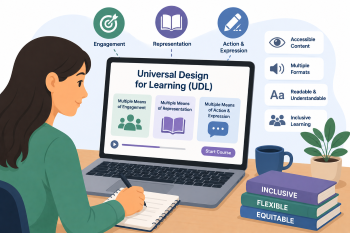
En 45-minuters workshop där språkskolelärare får en introduktion till Universal Design for Learning (UDL) samtidigt som de lär sig att använda Google LM:s Notebook- och Study-funktioner (t.ex. podcast och quiz) som verktyg för etisk, inkluderande lärandesign och professionell utveckling.
DigCompEdu-Kompetensområde(n)
1 Professionellt engagemang, 2 Digitala resurser, 3 Undervisning och lärande, 4 Bedömning, 5 Stärka elevernas egenmakt, 6 Underlätta elevernas digitala kompetens
Tid
Preparation time 60 minutes
Genomförande: 45 min
Utbildningspersonals Nivå
Nybörjare, Utforskare, Integrerare, Expert, Ledare, Pionjär
Målgrupp
Språklärare
Minimikrav på Elevernas Digitala Färdigheter
Grundläggande
Minimikrav på Elevernas Språknivå
A1–C2 (språkoberoende aktivitet)
🎓 Lärandemål
Lärarna ska kunna…
- Förklara de grundläggande principerna för universell utformning för lärande (UDL).
- Inse hur olika studieformat (text, ljud, frågesport) stöder olika dimensioner av UDL.
- Använda funktionerna Notebook och Study i Google LM för att utforska och lära sig nytt pedagogiskt innehåll.
- Reflektera över hur AI-stödda studieverktyg kan stödja inkluderande undervisningsplanering inom vuxenutbildning i språk.
Ingredienser
| Objekt / Resurs | Antal | Syfte |
|---|---|---|
| AI-verktyg: Google LM (Notebook- och Study-funktioner) | 1 per deltagare | Används som den primära inlärningsmiljön. |
| AI-genererat och av utbildaren sammanställt UDL-läromaterial (PDF) | 1 uppsättning | Laddas upp till Google LM Notebook för att visa hur teoretiskt innehåll kan studeras i olika format. |
| Innehållsmaterial (utdrag ur UDL-ramverket, exempel) | Utvalda | Ger en gemensam teoretisk utgångspunkt för alla elever och stödjer strukturerad diskussion och reflektion. |
Utrustning
Enhet med internetanslutning (bärbar dator eller surfplatta) + tillgång till Google LM
🥣 Förberedelser – före genomförandet
Det reviderade, forskningsbaserade innehållet exporteras som PDF-filer och laddas upp till Google LM Notebook, där det fungerar som det centrala studiematerialet för workshopen.
🔥 Steg för implementering (i klassrummet/synkront)
- Kursledaren presenterar de grundläggande principerna för Universal Design for Learning (UDL) och förklarar hur Google LM kommer att användas som en inlärningsmiljö snarare än som ett verktyg för att skapa innehåll.
- Eleverna öppnar de uppladdade PDF-filerna med UDL-forskning i Google LM Notebook och utforskar innehållet med hjälp av utvalda studieverktyg, bland annat:
- AI-genererade sammanfattningar
- Quizbaserade kunskapskontroller
- Förklaringar i podcastformat
- Utdragning av nyckelpunkter
🧂 Anpassning och inkludering
Genom att uppleva flera olika studieformat när de arbetar med samma teoretiska innehåll utforskar lärarna hur differentiering kan integreras i lärandesignen snarare än att genomföras som individuella anpassningar.
🥄 Bedömning och återkoppling
| Kriterium | Utmärkt | Bra | Behöver förbättras |
| Förståelse för UDL-principerna | Visar en tydlig och korrekt förståelse för de centrala UDL-principerna och deras syfte. | Visar en grundläggande förståelse för UDL-principerna med mindre brister. | Begränsad eller oklar förståelse av UDL-principerna. |
| Användning av funktionerna i Google LM Study | Utforskar aktivt flera Study-funktioner och reflekterar över deras pedagogiska potential. | Använder utvalda Study-funktioner med begränsad reflektion. | Minimalt engagemang i Study-funktionerna. |
⚠️ Etik, integritet och säkerhet
- Lärare uppmanas att inte ladda upp personuppgifter, känslig information eller uppgifter som kan identifiera elever när de använder Google LM. Allt material som används under workshopen ska vara allmänt hållet och forskningsbaserat.
- Tänk på att AI-genererade resultat endast är hjälpmedel, inte auktoritativa källor.
🍱 Fördjupning / Uppföljningar
Lärare uppmuntras att ytterligare utforska Google LM:s Study-funktioner med hjälp av sina egna facklitterära texter eller forskningstexter.
🔗 Ämnesövergripande koppling
Referenser och resurser
CAST – Universal Design for Learning (UDL) Framework:
Center for Applied Special Technology (CAST), den USA-baserade forskningsorganisationen som utvecklade UDL-ramverket. CAST grundades av forskare knutna till Harvard Graduate School of Education och är den främsta auktoritativa källan när det gäller UDL-teori och riktlinjer. https://udlguidelines.cast.org https://udlguidelines.cast.org
Universal Design for Learning: Teori och praktik
Meyer, A., Rose, D. H., & Gordon, D. (2014). Universal Design for Learning: Theory and Practice. CAST Professional Publishing. https://udltheorypractice.cast.org https://udltheorypractice.cast.org
Google LM Notebook: Google LM Notebook: Googles AI-stödda studie- och kunskapsmiljö som användes i workshopen för att utforska forskningstexter genom flera olika studieformat (t.ex. sammanfattningar, frågesporter, ljud). https://notebooklm.google.com https://notebooklm.google.com