
Using AI for Real-World Role-Plays
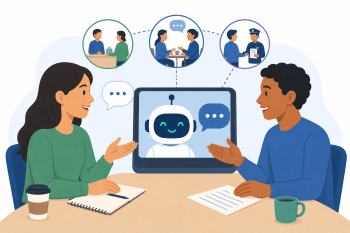
Educators learn to use AI chatbots to generate and simulate authentic, dynamic conversation scenarios for learners to practice, moving beyond simple phrase translation.
Τομέας(-είς) ικανοτήτων DigCompEdu
Digital resources, Teaching & learning, Empowering learners, Facilitating learners’ digital competence
Χρόνος
Preparation time 10 minutes
Implementation time 75 minutes
Επίπεδο Εξέλιξης Εκπαιδευτικού
Εξερευνητής
Ομάδες-στόχοι
Any
Ελάχιστο επίπεδο ψηφιακών δεξιοτήτων των μαθητών
None
Ελάχιστο επίπεδο γλωσσομάθειας του μαθητή
A1
🎓 Μαθησιακοί Στόχοι
Educators will be able to:
- Craft a prompt that generates a realistic dialogue for a specific scenario.
- Use a chatbot to role-play one side of a conversation, adapting to user input.
- Identify how this technique can support differentiation and personalization.
Συστατικά
| Είδος / Πόρος | Ποσότητα | Σκοπός |
|---|---|---|
| AI tool(s) (e.g., ChatGPT, Claude) | 1 per person | Role-play partner & script generator |
| Content materials (Scenario cards) | 1 set | Ideas for role-plays |
Εξοπλισμός
- Devices: One laptop or tablet per educator.
- Internet: Stable Wi-Fi.
- AI Tool Access: Access to a free, conversational AI chatbot.
🥣 Προετοιμασία – Πριν από την υλοποίηση
- Scenario Cards: Prepare a set of “scenario cards” with relevant situations (e.g., “Calling a landlord to report a leak,” “Asking for a day off work,” “Complaining about a faulty product in a shop”).
- Tool Familiarization: Test the role-play functionality of your chosen AI tool beforehand to ensure smooth demonstration.
🔥 Βήματα υλοποίησης
1. Introduction & Demo (15 mins):
- Demonstrate the difference between a simple translation tool and a conversational AI. Highlight how AI can simulate dynamic interactions.
- Show how to set up a role-play scenario within the AI chatbot.
- Sample Prompt 1 (Dialogue Generation): “Write a short, simple dialogue between a customer and a shop assistant. The customer is returning a faulty toaster. Use A2-level English.”
2. Live Role-Play Demonstration (15 mins):
- Show the powerful follow-up step: making the AI act as one participant in the dialogue.
- Sample Prompt 2 (Live Role-Play): “You are the shop assistant in the dialogue you just generated. I will be the customer. Respond to me appropriately. Keep your responses short and clear for an A2 learner.”
- Conduct a live text-based conversation with the AI to illustrate its interactive capabilities.
3. Guided Practice (30 mins):
- Educators select a scenario card and first generate a dialogue using the AI.
- Then, they practice the live role-play with the AI, taking turns being the learner and observing the AI’s responses.
4. Discussion & Application (15 mins):
- Educators discuss: How could this be used in class? (e.g., for homework practice, for generating model dialogues, for one-on-one support).
- Brainstorm a list of other useful scenarios relevant to adult migrants.
- Tip: Show educators how to add constraints to the prompt, such as “Use only the present simple tense” or “Include phrases for being polite.”
🧂 Διαφοροποίηση και Συμπερίληψη
- For less confident educators: Provide simpler, more concrete scenarios (e.g., “Ordering a coffee”) and pre-written prompts.
- For advanced users: Introduce the concept of asking the AI to correct the learner’s grammar during the role-play, or to provide feedback on pronunciation if using voice-based AI.
🍴 Αξιολόγηση και ανατροφοδότηση
| Κριτήριο | Έξοχα | Καλά | Χρειάζεται δουλειά |
| Scenario Generation | Creates a realistic, level-appropriate dialogue | Creates a basic, usable dialogue | Struggles to formulate a coherent scenario |
| Live Role-Play Setup | Successfully instructs AI to act as a character and engages in a conversation | Sets up the role-play but interaction is limited | Cannot set up the interactive role-play feature |
⚠️ Ηθική, Ιδιωτικότητα & Διασφάλιση Προστασίας
- Learner Anonymity: Remind educators that learners should use nicknames and avoid sharing personal details during AI role-plays.
- Unexpected Responses: The AI might generate unexpected or inappropriate responses; learners should be advised to stop if they feel uncomfortable and report it to the educator.
- Educator Oversight: Emphasize that the AI is a tool for practice, and the educator’s guidance and feedback remain crucial.
🍱 Επεκτάσεις / Συνέχειες
- Prompt Bank: Create a shared bank of pre-tested role-play prompts for common scenarios.
- Voice-Based AI: Explore voice-based AI assistants for speaking and pronunciation practice, adding another dimension to role-playing.
- Advanced Scenarios: Challenge educators to create multi-turn, complex role-plays that require more nuanced language and problem-solving.
🔗 Σύνδεση μεταξύ γνωστικών αντικειμένων
Αναφορές και Πηγές
Claude: claude.ai – Often excellent at following complex role-play instructions.
ChatGPT: chat.openai.com – Widely accessible and effective for this purpose