
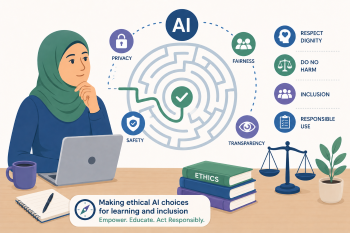
Navigating the Ethics Maze – AI Ethics for Adult Migrant Educators
An interactive workshop helping educators explore real-world AI ethics dilemmas in the context of adult migrant education, building critical awareness and responsible AI use practices.
Τομέας(-είς) ικανοτήτων DigCompEdu
Professional engagement, Assessment, Empowering learners, Facilitating learners’ digital competence
Χρόνος
Preparation time 30 minutes
Implementation time 90 minutes
Επίπεδο Εξέλιξης Εκπαιδευτικού
Ολοκληρωτής
Ομάδες-στόχοι
Educators of adult migrants Any language level
Ελάχιστο επίπεδο ψηφιακών δεξιοτήτων των μαθητών
Βασικό
Ελάχιστο επίπεδο γλωσσομάθειας του μαθητή
B1
🎓 Μαθησιακοί Στόχοι
Participants (educators) will be able to:
- Identify key ethical issues in AI use within adult migrant education contexts.
- Apply ethical frameworks to real-world AI dilemmas faced by educators.
- Develop personal and institutional guidelines for responsible AI use.
- Facilitate ethical discussions about AI with their own learners.
Συστατικά
| Είδος / Πόρος | Ποσότητα | Σκοπός |
|---|---|---|
| Ethics Maze scenario cards | 1 set per group | Real-world AI ethics dilemmas for discussion |
| AI Ethics Framework handout | 1 per participant | Reference guide for ethical decision-making |
| Devices with internet access | 1 per participant | To explore AI tools during the workshop |
| Shared digital workspace (Padlet or Jamboard) | 1 per group | To record and share ethical reflections |
| Voting cards or digital polling tool | 1 set per group | For structured ethical debate activities |
Εξοπλισμός
- Projector or shared screen for scenario presentations
- Devices with internet access for all participants
- Printed or digital scenario cards with AI ethics dilemmas
- Whiteboard or flip chart for capturing group responses
🥣 Προετοιμασία – Πριν από την υλοποίηση
- Prepare 6-8 scenario cards describing realistic AI ethics dilemmas in adult migrant education (e.g. using AI to assess learner progress without consent, AI-generated content that reinforces stereotypes, sharing learner data with AI tools).
- Prepare the AI Ethics Framework handout covering: privacy, consent, bias, transparency, and accountability.
- Set up a shared digital workspace (Padlet or Jamboard) for group reflections.
- Test all AI tools to be referenced during the workshop.
🔥 Βήματα υλοποίησης
- Introduction (15 min): Open with a provocative question: “Is it ethical to use AI to grade your students?” Collect responses. Introduce the five key AI ethics principles: privacy, consent, bias, transparency, and accountability.
- The Ethics Maze – Scenario Rounds (45 min): Groups receive a scenario card and must navigate the “maze” by answering: What is the ethical issue? Who is affected? What should the educator do? Groups rotate through 3-4 scenarios.
- Gallery Walk (15 min): Groups post their responses on the shared digital workspace. Participants review and add comments or questions to other groups’ responses.
- Whole-Group Debrief (15 min): Facilitator highlights key themes and tensions. Discuss: Are there situations where there is no clear right answer?
- Personal Action Planning (10 min): Each participant writes one commitment: “In my teaching, I will… to use AI more ethically.”
🧂 Διαφοροποίηση και Συμπερίληψη
- For less experienced educators: Use simpler scenarios focused on familiar classroom situations.
- For advanced participants: Introduce more complex scenarios involving institutional policy and legal compliance.
- For multilingual groups: Allow discussion in participants’ preferred language before sharing in the workshop language.
🍴 Αξιολόγηση και ανατροφοδότηση
| Κριτήριο | Έξοχα | Καλά | Χρειάζεται δουλειά |
| Ethical reasoning | Demonstrates nuanced, multi-perspective ethical reasoning across scenarios | Shows sound ethical reasoning with some gaps | Ethical reasoning is limited or one-dimensional |
| Application to practice | Connects ethical principles clearly to specific classroom situations | Makes some connections to practice with support | Struggles to connect abstract ethics to classroom context |
| Action planning | Produces a specific, actionable, and realistic ethical commitment | Produces a general commitment with some specificity | Commitment is vague or not connected to AI use |
⚠️ Ηθική, Ιδιωτικότητα & Διασφάλιση Προστασίας
- Acknowledge that ethical AI use is an ongoing process, not a one-time decision.
- Avoid presenting ethics as a set of rigid rules; emphasise professional judgement and context.
- Be sensitive to participants who may have personal experiences of data misuse or surveillance.
- Ensure the workshop itself models the ethical principles being discussed (e.g. no recording without consent).
- Follow institutional policies on AI use and data protection throughout the workshop
🍱 Επεκτάσεις / Συνέχειες
- Develop an institutional AI Ethics Policy collaboratively with participants.
- Create a classroom version of the Ethics Maze for use with adult learners.
- Follow up with a case study analysis of a real AI ethics incident in education.
🔗 Σύνδεση μεταξύ γνωστικών αντικειμένων
Αναφορές και Πηγές
UNESCO AI Ethics Recommendation: https://www.unesco.org/en/artificial-intelligence/recommendation-ethics
European Commission AI Act: https://digital-strategy.ec.europa.eu/en/policies/regulatory-framework-ai
DigCompEdu Framework: https://joint-research-centre.ec.europa.eu/digcompedu_en
AI Fairness 360: https://aif360.mybluemix.net