
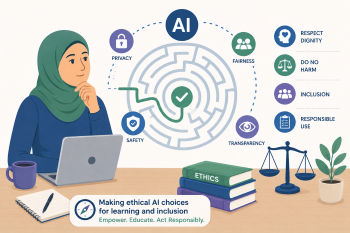
Navigating the Ethics Maze – AI Ethics for Adult Migrant Educators
An interactive workshop helping educators explore real-world AI ethics dilemmas in the context of adult migrant education, building critical awareness and responsible AI use practices.
DigCompEdu Competence Area(s)
Professional engagement, Assessment, Empowering learners, Facilitating learners’ digital competence
Time
Preparation time 30 minutes
Implementation time 90 minutes
Educator Progression Level
Integrator
Target groups
Educators of adult migrants Any language level
Minimum student digital skill level
Basic
Minimum student language level
B1
🎓 Learning Objectives
Participants (educators) will be able to:
- Identify key ethical issues in AI use within adult migrant education contexts.
- Apply ethical frameworks to real-world AI dilemmas faced by educators.
- Develop personal and institutional guidelines for responsible AI use.
- Facilitate ethical discussions about AI with their own learners.
Ingredients
| Item / Resource | Quantity | Purpose |
|---|---|---|
| Ethics Maze scenario cards | 1 set per group | Real-world AI ethics dilemmas for discussion |
| AI Ethics Framework handout | 1 per participant | Reference guide for ethical decision-making |
| Devices with internet access | 1 per participant | To explore AI tools during the workshop |
| Shared digital workspace (Padlet or Jamboard) | 1 per group | To record and share ethical reflections |
| Voting cards or digital polling tool | 1 set per group | For structured ethical debate activities |
Utensils
- Projector or shared screen for scenario presentations
- Devices with internet access for all participants
- Printed or digital scenario cards with AI ethics dilemmas
- Whiteboard or flip chart for capturing group responses
🥣 Preparation – Before Implementation
- Prepare 6-8 scenario cards describing realistic AI ethics dilemmas in adult migrant education (e.g. using AI to assess learner progress without consent, AI-generated content that reinforces stereotypes, sharing learner data with AI tools).
- Prepare the AI Ethics Framework handout covering: privacy, consent, bias, transparency, and accountability.
- Set up a shared digital workspace (Padlet or Jamboard) for group reflections.
- Test all AI tools to be referenced during the workshop.
🔥 Implementation Steps
- Introduction (15 min): Open with a provocative question: “Is it ethical to use AI to grade your students?” Collect responses. Introduce the five key AI ethics principles: privacy, consent, bias, transparency, and accountability.
- The Ethics Maze – Scenario Rounds (45 min): Groups receive a scenario card and must navigate the “maze” by answering: What is the ethical issue? Who is affected? What should the educator do? Groups rotate through 3-4 scenarios.
- Gallery Walk (15 min): Groups post their responses on the shared digital workspace. Participants review and add comments or questions to other groups’ responses.
- Whole-Group Debrief (15 min): Facilitator highlights key themes and tensions. Discuss: Are there situations where there is no clear right answer?
- Personal Action Planning (10 min): Each participant writes one commitment: “In my teaching, I will… to use AI more ethically.”
🧂 Differentiation & Inclusion
- For less experienced educators: Use simpler scenarios focused on familiar classroom situations.
- For advanced participants: Introduce more complex scenarios involving institutional policy and legal compliance.
- For multilingual groups: Allow discussion in participants’ preferred language before sharing in the workshop language.
🍴 Assessment & Feedback
| Criterion | Excellent | Good | Needs Work |
| Ethical reasoning | Demonstrates nuanced, multi-perspective ethical reasoning across scenarios | Shows sound ethical reasoning with some gaps | Ethical reasoning is limited or one-dimensional |
| Application to practice | Connects ethical principles clearly to specific classroom situations | Makes some connections to practice with support | Struggles to connect abstract ethics to classroom context |
| Action planning | Produces a specific, actionable, and realistic ethical commitment | Produces a general commitment with some specificity | Commitment is vague or not connected to AI use |
⚠️ Ethics, Privacy & Safeguarding
- Acknowledge that ethical AI use is an ongoing process, not a one-time decision.
- Avoid presenting ethics as a set of rigid rules; emphasise professional judgement and context.
- Be sensitive to participants who may have personal experiences of data misuse or surveillance.
- Ensure the workshop itself models the ethical principles being discussed (e.g. no recording without consent).
- Follow institutional policies on AI use and data protection throughout the workshop
🍱 Extensions / Follow‑Ups
- Develop an institutional AI Ethics Policy collaboratively with participants.
- Create a classroom version of the Ethics Maze for use with adult learners.
- Follow up with a case study analysis of a real AI ethics incident in education.
🔗 Cross‑Subject Link
References & Resources
UNESCO AI Ethics Recommendation: https://www.unesco.org/en/artificial-intelligence/recommendation-ethics
European Commission AI Act: https://digital-strategy.ec.europa.eu/en/policies/regulatory-framework-ai
DigCompEdu Framework: https://joint-research-centre.ec.europa.eu/digcompedu_en
AI Fairness 360: https://aif360.mybluemix.net