
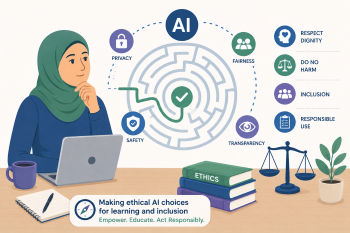
Navigering i den etiske labyrint: AI-etik for voksne migrantundervisere
En interaktiv workshop, der hjælper undervisere med at udforske etiske dilemmaer omkring AI i den virkelige verden i forbindelse med uddannelse af voksne migranter, opbygge kritisk bevidsthed og ansvarlig brug af AI.
DIGCOMPEDU KOMPETENCEOMRÅDE(R)
Professionelt engagement, Evaluering, Styrkelse af kursister, Fremme af kursisters digitale kompetence
Tid
Forberedelse: 30 min
Implementering: 90 min
Underviserens progressionsniveau
Integrator – Ekspert
Målgruppe
Undervisere for voksne migranter
MINIMUM DIGITAL FÆRDIGHEDSNIVEAU FOR KURSISTER
Grundlæggende, Mellem
MINIMUM KURSISTENS SPROGNIVEAU
B1 – C1
🎓 Læringsmål
Læringsmål:
- Identificér centrale etiske problemstillinger i forbindelse med brug af kunstig intelligens i forbindelse med uddannelse af voksne migranter.
- Anvend etiske rammer på virkelige AI-dilemmaer, som undervisere står over for.
- Udvikl personlige og institutionelle retningslinjer for ansvarlig brug af AI.
- Facilitér etiske diskussioner om AI med egne kursister.
Ingredienser
| Ressource | Mængde | Formål |
|---|---|---|
| Etiklabyrint-scenariekort | 1 sæt pr. gruppe | Etiske dilemmaer om AI i den virkelige verden til diskussion |
| Handout om AI-etiske rammer | 1 pr. underviser | Reference-vejledning til etisk beslutnings-tagning |
| Enheder med internetadgang | 1 pr. underviser | At udforske AI-værktøjer under workshoppen |
| Delt digitalt arbejdsområde (Padlet eller Jamboard) | 1 pr. gruppe | At registrere og dele etiske refleksioner |
| Stemmekort eller digitalt valgværktøj | 1 sæt pr. gruppe | Til strukturerede etiske debat-aktiviteter |
🔧 Redskaber
- Projektor eller delt lærred til scenariepræsentationer
- Enheder med internetadgang for alle deltagere
- Trykte eller digitale scenariekort med etiske dilemmaer vedrørende AI
- Whiteboard eller flipover til at registrere gruppens svar
🥣 Forberedelse – før gennemførslen
- 1. Forbered 6-8 scenariekort, der beskriver realistiske etiske dilemmaer relateret til kunstig intelligens i voksenuddannelse for migranter (fx brug af kunstig intelligens til at vurdere kursisters fremskridt uden samtykke, kunstig intelligens-genereret indhold, der forstærker stereotyper, deling af kursistdata med kunstig intelligens-værktøjer).
- 2. Forbered udleveringsmaterialet til AI-etikrammen, der dækker: privatliv, samtykke, bias, gennemsigtighed og ansvarlighed.
- 3. Opret et delt digitalt arbejdsområde (Padlet eller Jamboard) til grupperefleksioner.
- 4. Test alle AI-værktøjer, der skal bruges som reference under workshoppen.
🔥 Trin i klassen/online
- 1. Introduktion (15 min): Start med et provokerende spørgsmål: "Er det etisk at bruge AI til at bedømme sine kursister?" Indsaml svar. Introducer de fem centrale etiske principper for AI: privatliv, samtykke, bias, gennemsigtighed og ansvarlighed.
- 2. Den etiske labyrint - Scenarierunder (45 min): Grupperne modtager et scenariekort og skal navigere i "labyrinten" ved at besvare: Hvad er det etiske problem? Hvem er berørt? Hvad skal underviseren gøre? Grupperne roterer gennem 3-4 scenarier.
- 3. Gallerivandring (15 min): Grupperne poster deres svar på det delte digitale arbejdsområde. Deltagerne gennemgår og tilføjer kommentarer eller spørgsmål til andre gruppers svar.
- 4. Debriefing for hele gruppen (15 min): Facilitator fremhæver centrale temaer og spændinger. Diskuter: Er der situationer, hvor der ikke er et klart rigtigt svar?
- 5. Personlig handlingsplanlægning (10 min): Hver deltager skriver én forpligtelse: "I min undervisning vil jeg... bruge AI mere etisk."
🧂 Differentiering og inklusion
- For mindre erfarne undervisere: Brug enklere scenarier med fokus på velkendte klassesituationer.
- For avancerede deltagere: Introducer mere komplekse scenarier, der involverer institutionel politik og overholdelse af lovgivningen.
- For flersprogede grupper: Tillad diskussion på deltagernes foretrukne sprog, før deling på workshoppens sprog.
🥄 Vurdering og feedback
| Kriterier | Fremragende | God | Behøver arbejde |
| Etisk ræsonnement | Demonstrerer nuanceret, etisk ræsonnement med tværgående perspektiver på tværs af scenarier | Viser solid etisk argumentation med nogle mangler | Etisk ræsonnement er begrænset eller endimensionelt |
| Ansøgning til praksis | Forbinder etiske principper tydeligt med specifikke klassesituationer | Skaber nogle forbindelser til praksis med støtte | Kæmper med at forbinde abstrakt etik med klasseværelseskonteksten |
| Handlingsplanlægning | Skaber en specifik, handlingsrettet og realistisk etisk forpligtelse | Skaber en generel forpligtelse med en vis specificitet | Forpligtelsen er vag eller ikke forbundet med brugen af AI |
⚠️ Etik, privatliv og beskyttelse
- Anerkend, at etisk brug af AI er en løbende proces, ikke en engangsbeslutning.
- Undgå at præsentere etik som et sæt rigide regler; læg vægt på professionel dømmekraft og kontekst.
- Vær opmærksom på deltagere, der kan have personlige oplevelser med datamisbrug eller overvågning.
- Sørg for, at selve workshoppen er et eksempel på de etiske principper, der diskuteres (fx ingen optagelse uden samtykke).
- Følg institutionens politikker for brug af AI og databeskyttelse under hele workshoppen.
🍱 Udvidelser/opfølgninger
- Udvikl en institutionel etikpolitik for AI i samarbejde med deltagerne.
- Lav en klasseværelsesversion af Etiklabyrinten til brug med voksne kursister.
- Følg op med en casestudieanalyse af en reel AI-etisk hændelse i uddannelsessektoren.
🔗 Brug AI på tværs af fag
📚 Referencer og ressourcer
UNESCO AI Ethics Recommendation: https://www.unesco.org/en/artificial-intelligence/recommendation-ethics
European Commission AI Act: https://digital-strategy.ec.europa.eu/en/policies/regulatory-framework-ai
DigCompEdu Framework: https://joint-research-centre.ec.europa.eu/digcompedu_en
AI Fairness 360: https://aif360.mybluemix.net